Saturday, 4 May 2013

Ray Wood rhododendrons on show

One of the largest rhododendrons in the collection, R. basilicum

One of the smallest: R. petrocharis, Jim Russell's own collection from Fan Jin Shan, October 1985,
under the number GUIZ 120. A very rare plant in cultivation, it seems.

An excellent example of Jim Russell's planting in Ray Wood - a beautiful mix of colours.
The collection of rhododendrons planted by Jim Russsell in Ray Wood at Castle Howard during the 1970s and 80s has long been regarded as being of exceptional interest - not only for its diversity but for its location. North-eastern England is not generally regarded as the best place to grow good rhododendrons, but Jim knew what he was doing, choosing a cool north-facing site with constantly moist rich soil, with remarkable results. Unfortunately this treasure trove was badly neglected after he died, until the Castle Howard Arboretum Trust received a very generous grant from the Monument Trust to undertake its restoration. This began in 2010, with Jan Hoyland as Curator. Together with her assistant Jonathan Watkinson , and a dedicated group of volunteers, she rescued the woodland garden in Ray Wood from oblivion under the closed canopy of increasingly large oaks, and from being swallowed under laurels and brambles. The work is still going on, now under my guidance, but the past couple of years' hard work is showing in the current superb display of a diversity of rhododendrons in full flower.

Cut stems for the show  brought down from Ray Wood.
To celebrate this resurgence, and help tell a wider audience that Ray Wood is worth visiting again, I took a selection of cut stems to the RHS Late Rhododendron Competition being held at Harlow Carr, Harrogate, this weekend. Nicola Hall, our Plant Records Manager, helped gather the flowers yesterday, and I staged them on behalf of the Ray Wood Volunteers this morning. I learnt a lot in a hurry about staging rhododendrons to the satisfacton of the judges, but we were awarded two firsts (for a trio of hybrids, and a single truss of a hybrid) a second, a third, a fourth and a disqualified (a magnificent stem of R. basilicum deemed to have three trusses instead of the permitted one). Not too bad for a first attempt!

Part of the Late Rhododendron Competion at RHS Harlow Carr today. Five Ray Wood specimens are visible on the front table (not the pale one on the right)

The first prize-winning trio of hybrids (fron to back): 'Juanita', 'Carita' and 'Ibex'

card for 'Taurus'

'Taurus' in situ.


Wednesday, 1 May 2013

Pleione

Pleione Britannia 'Doreen'
I came home from the arboretum this afternoonn to find that the pots of Pleione in the 'conservatory' were catching the sun, so I spent some time trying to catch the effect with the camera. Here are a few of the results.

Pleione Irazu 'Cheryl'

Pleione Tongariro

Tongariro

The full pot of Tongariro - an outstanding plant.

Saturday, 27 April 2013

Birthday party flowers

Magnolia 'Star Wars'
 Flowers in my parents' garden today, where we have been celebrating my mother's birthday.

Gladiolus cunonius

Scadoxus puniceus

Cowslips (Primula veris) in the lawn

Viola from Morrisons

Muscari neglectum (selected)

Lithodora zahnii

Narcissus papyraceus

Leucojum aestivum 'Gravetye'

Convallaria majalis 'Vic Pawlowski's Gold'

Trillium chloropetalum (Primrose Warburg's clone)


Thursday, 25 April 2013

Happy Birthday Susan Grimshaw

Galanthus nivalis 'Susan Grimshaw'
My mother, Susan Grimshaw, has a significant birthday today, to commemorate which I have decided to name (with her permission) my favourite snowdrop seedling after her. Galanthus nivalis 'Susan Grimshaw' flowers towards the end of the season and, for G. nivalis, has large flowers with long outer segments that I think are held with particular elegance of poise. They are crisply marked with green lines and the inner segment marking is bold too. Adding further to its quality is the fact that the leaves are more or less prostrate, meaning that the flowers stand up cleanly above the foliage. It seems to be a good doer, and was much admired in my garden at Colesbourne where it was selected (and also when it has appeared anonymously on this blog, e.g. 10 January 2011, 2 March 2011).

Happy Birthday Ma!

Monday, 22 April 2013

Conserving Rhododendrons

Rhododendron hyacinthosmum, a vireya from Papua New Guinea with a delicious scent reminiscent of, but much nicer than, hyacinths.
 I am recovering from an intensive couple of days in Edinburgh, where I attended a conference on the conservation of Rhododendron species, both in the wild and in cultivation. As curator of the collection in Ray Wood at Castle Howard I am responsible for maintaining alarge number of plants, some of which are very rare indeed: a fellow attendee asked if we still had R. lanatoides, as there were only three known plants in cultivation. Fortunately we do.

Organised by the the Rhododendron Species Conservation Group, with strong support from Botanic Gardens Conservation International and the Royal Botanic Garden Edinburgh, where the conference was held, the talks and discussions ranged widely across the mountains of Asia and the gardens of the world. It was an extraordinary gathering of knowledge, with a collective knowledge of rhododendrons and their localities such as can seldom have been gathered together before. These snippets of conversation give something of the flavour:  'I've seen it on the Doshong La'; 'They're all hybrids up there'; 'the bulldozers were going flat-out, there'll be nothing left now'; 'it's a new species'; 'there are several new species up there'; 'it has hairy pedicels'; 'I don't fancy that road in an earthquake'; 'I don't know why they bother with Sapa, north-eastern Vietnam is much better'; 'you get permission from the Maoists, not the government'; 'we're going into Burma this year.' I've only seen a handful of rhododendrons in the wild, so could only listen, but it was exhilarating stuff.

A tiny vireya from New Guinea, Rhododendron rubineiflorum. The size can be judged from the Oxalis leaf.

We did get the chance to look around the garden on Saturday afternoon, with guided tours led by the official experts Drs David Chamberlain and George Argent. George's speciality is Rhododendron subgenus Vireya, an almost exclusively tropical group, with no hardy representatives. In consequence it is poorly known in this country, but in fact vireyas account for a third of the total diversity of the genus. They are most abundant in Indonesia and on the island of New Guinea, usually growing in the higher, cooler parts of the forest, sometimes being confined to single mountaintops which makes them of particular conservation concern. Their floral shape and coloration is incredibly diverse and their fascination is undeniable, so my pictures today are all of vireyas, but they only graze the surface of their variation..

R. himantodes, an epiphyte from Borneo.

R. loranthiflorum 'Dick Shaw'

Another Papuan species, R. aurigeranum
 
R. taxifolium, collected by George Argent from a mountain in the Philippines where the forest was being cleared for cabbages: it is regarded as Critically Endangered in the wild.

Breeders have been working on vireyas since the 19th C: this is 'Ne Plus Ultra'. Cultivars are very popular in places such as Hawaii and New Zealand.


Tuesday, 16 April 2013

On the cusp of spring in Belgium

The flowers of Acer pycnanthum, a rare Japanese species, at Arboretum Wespelaar.

A lowering sky on Friday afternoon soon delivered its load of rain, but in so doing banished the cold east wind.
I spent a very enjoyable long weekend in Belgium, as a guest speaker at the Magnolia Study Weekend organised by Arboretum Wespelaar, which has one of the finest collections of magnolias in Europe. Sadly, the bitter winter has either killed the buds outright or delayed their opening, depending on variety, so that Magnolia flowers were very sparse: even M. stellata and its close relatives were only just getting going. But there was plenty of interest to see in this great arboretum, and with 60 other plantspeople present there was no shortage of conversation (in a babel of languages). In addition to my own contribution there were four other speakers, all very illustrious indeed in the world of magnolias (which I most certainly am not), and their talks conveyed their passion for the genus and its continuing development. Most exciting to me was the news of wide and wild crosses being made in (especially) the United States, with hybrids now known and flowering between such improbable parents as M. grandiflora and M. sieboldii (upright-flowered but with red stamens), and M. insignis (formerly in Manglietia) and M. sieboldii (semi-pendulous with uniformly soft pink tepals), and the tempting (perhaps) prospect of something pink in the style of M. grandiflora...

The magnolias at Wespelaar are covered in incredible numbers of buds but many have been frosted.

Only the earliest magnolias were in flower, such sas this M. stellata (tetraploid)

Anemone nemorosa

Pieris 'Valley Valentine' at Arboretum Wespelaar
While in Belgium the weather and season changed from winter to spring: the cold east wind was pushed back on Friday afternoon by a front of rain from the west, which cleared to introduce mild air from the south, enabling a glorious sunny, warm day on Subday, when we visited Arboretum Bokrijk near Genk. Owned by the Province of Limburg, this is a relatively unknown gem, with a good selection of interesting trees and other plants, well worth exploring.


Lysichitum americanum in warm sunshine at Arboretrum Bokrijk on Sunday afternoon.

Magnolia stellata 'Royal Star' at Bokrijk.

The speakers: JMG, Andrew Bunting, Philippe de Spoelberch, Jim Gardiner, Koen Camelbeke.

Sunday, 7 April 2013

Busy in the garden

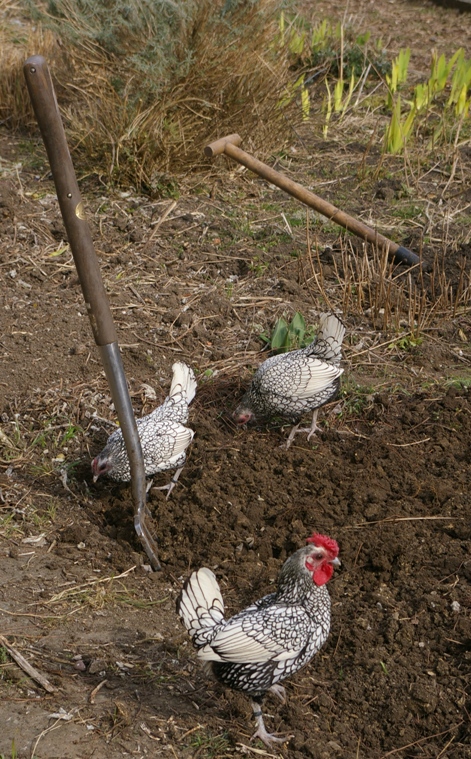
The Silver Sebrights helping as I dig the border: they are very fond of small snails.
With the weather having finally turned for the better it is at last a pleasure to be outside and working in the garden. There re lots of things to be done, but the task taking most energy is digging the big border that runs in front of the house. It was generously planted in a pastel scheme by my predecessor in the house, but had not been effectively gardened for some time before I moved in last August. In consequence the weeds had begun to get established, so a thorough digging is needed to rid it of nettles, couch and creeping buttercup before they get too rampant. As many of these are interwoven between extant plants it is easiest to get rid of these too -and I certainly don't want square yards of Stachys byzantina or Geranium renardii, however pretty they may be. I'll keep a few bits of each though, and there are other things to work round in situ, but in general the bed is being emptied and thoroughly turned over. The soil is good brown loam with very few stones, but evidently alkaline. It should grow most perennials very well - and they're waiting to be planted.

A peony that remains in situ in the border - is it going to turn out to be P. mlokosewitschii?

A tray of Campanula latifolia divisions from clumps in the border; they will look well under trees in the arboretum.

The succulents and clivias in big pots have all been given a thorough soaking to rejuvenate them after the winter. I keep them rather dry to prevent them growing much indoors in winter.

The guard is changing: the early daffodils are now more conspicuous than the fading snowdrops. This is Narcissus perez-chiscanoi.