Monday, 19 March 2012

Monday morning

Mist on the lake banks.
 Every Monday morning it is the ritual for Will Fletcher and I to walk round the garden, enabling us to check that all is well (or find that it is not), to plan the work for the week ahead and of course to catch up with the gossip, such as there is in Colesbourne. I think it's the most important thing we do each week, especially as in a large garden there would otherwise be little need to visit some of the remoter corners at other times.

I recently acquired a copy of John Evelyn's Directions for the Gardiner and other Horticultural Advice, edited by Maggie Campbell-Culver (OUP 2009), a charming volume bringing together three of Evelyn's horticultural works: Kalendarium Hortense, Directions for the Gardiner and Acetaria. All are full of excellent advice from an eminently practical man. The Directions for the Gardiner was a manuscript set of instructions for an apprentice gardner, Jonathan Mosse, who came to Evelyn's garden at Sayes Court on 24 June 1686, for six years. Not published until 1932, there is much that is of relevance to modern gardeners, including the instruction: 'The Gardiner should walk about the whole Gardens every Monday-morning duely, not omitting the least corner and obeserve what Flowers or Trees & plants want staking, binding andredressing, watering or are in danger... and then immediately to reforme, establish, shade, water etc what he finds amisse, before go about any other work.'

This Monday morning was crisp and bright, warming up rapidly after a sharp frost - a perfect spring day. Here are some pictures from our weekly walk.

For the last time this winter - frosty teasels.

Narcissus obvallaris


Prunus mume 'Beni-chidori'


Saturday, 17 March 2012

A long-awaited flowering

Zantedeschia odorata
In the late 1990s Kees Sahin gave me a plant of Zantedeschia odorata from his nursery at Ter Aar in Holland. It had been grown from South African seed. I can't recall now whether it had flowered by then, or whether it did in the next year or two once ensconced in the greenhouse at my parents'. I do know, however, that it has not bloomed for at least ten years and for much of that time it has been in something of a lingering state and on several occasions I've considered giving it the push. I brought it to Colesbourne a few years ago and have nurtured it along, though some years it has barely unfurled more than a leaf or two before going back into dormancy. Now at last it has managed to produce two inflorescences, the first of which opened earlier this week - the second is still to come. It's not easy to say what has triggered this success this year, but I think they had a good growing season the winter before, and I got them back into growth in late summer so they benefited from the longer warmer days of early autumn. I've also heard the recommendation that they should be kept very hot and dry in dormancy, but mine have not had those conditions.

Zantedeschia odorata was only described in 1989 and grows only in a limited area of the Bokkeveld near Nieuwoudtville (Northern Cape, South Africa) and even here it is limited in habitat to cracks in dolerite rock outcrops where its tubers cannot be dug by porcupines. The locus classicus is the area that is now the Hamtam National Botanic Garden, but when I visited in 2004 was still Glenlyon Farm, carefully managed for its wildflowers by the unique Neil McGregor. It was flowering well at the end of August, rather incongruously emerging from the rock, and it could be seen to be rather different to Z. aethiopica, with narrower spathes, narrower leaves and of course the pleasantly attractive scent. After flowering the infructescence arches to the ground instead of remaining upright as in Z. aethiopica. The two species will hybridize in cultivation, giving the potential of fragrance in white 'callas', though hopefully with the vigour and growability of Z. aethiopica.

Saturday, 10 March 2012

Not a snowdrop weekend - a few flowers from the cottage garden.

A multi-segmented Leucojum vernum
- about the nearest to a double-flowered form there is.

Hepatica nobilis 'Walter Otto' - a lovely double form of the hardy European species, selected in Germany.
 
Saxifraga juniperifolia

Cyclamen pseudibericum


A pale form of Chionodoxa forbesii

Small but perfectly formed: Narcissus 'Lionel Bacon'

Helleborus x ashwoodensis 'Pink Ice'

Galanthus nivalis 'Virescens': the original 'green snowdrop' and still beautiful, though it often doesn't last long in flower, thanks to its late flowering season.

Tuesday, 6 March 2012

Developments and challenges at Myddelton House


E.A. Bowles's alpine meadow at Myddelton House:
Leucojum vernum flowering with L. aestivum subsp. pulchellum in the foreground.

This afternoon I attended my first meeting of the Myddelton House Gardens Advisory Group, a body convened to advise the property's owners and gardeners on the management of this historic garden - and to keep a watchful eye on things too. I must say that it is rather a privilege to be asked to join the group, and be able to contribute something to the running of the garden which, through the writings of E.A. Bowles, inspired so much of my own gardening.

Free-fruiting mistletoe, Viscum album
I wrote in May last year about the reinvigoration of the garden thanks to a generous Heritage Lottery Fund grant, the backing of the Lee Valley Regional Park and particularly the dynamism of the Head Gardener, Andrew Turvey. As I hadn't been to Myddelton since last May Andrew showed me around before the meeting began, giving a chance to see a larger area of the garden than we covered in the official meeting. Daffodils are succeeding the last of the snowdrops and the alpine meadow, after several seasons of careful mowing, is now looking good once more.

Looking after a historic garden such as this, and bringing it back from a very low state is a huge challenge, which is certainly being risen to at Myddelton. Fifty or more years of entrenched weeds from Allium back to Acer are a constant problem and the more recent problem of increased pathogen load is evident in the unhealthy state of the box edging of the formal terrace beds,  probably afflicted with box blight. Managing these issues without compromising the integrity of the garden is a constant juggling act for all involved.

Unhealthy box edging on the terrace.

Fortunately, on the other side of the coin are the successes. Most notable, perhaps, is the restoration of the kitchen garden and its glasshouses. The Peach House was inaugurated last May by the Duchess of Cornwall - the peach tree she planted is now flowering - but since then a beautiful new range has been erected on the footprint of Bowles's glasshouses, incorporating the original tiled pathways. It has only recently been completed and most of the beds are still empty, though there is an impressive assemblage of succulents on the benches, but Andrew Turvey has ambitious plans for each of the three climate regimes available. Does anyone know a source for Strongylodon macrobotrys? The glasshouse will be officially opened in May, but we had a preview guided tour and were duly impressed.

Andrew Turvey (l) answers questions from members of the Gardens Advisory Group.

Monday, 5 March 2012

Grafting 'Rose of Ciren'

Sarah Juniper binding a new graft of 'Rose of Ciren' onto M27 stock.

With the end of the snowdrop season I am able to get away from Colesbourne in daylight again - and there is a lot of catching-up to do. Back in October 2010 I wrote about the rare apple variety 'Rose of Ciren' and said I'd be getting material of it grafted that winter. That never happened, thanks to the hard winter, and another attempt in January this year had to be aborted because of snow.

This afternoon, however, I finally got to Dursley with a bundle of graft wood for the attention of Sarah Juniper. Sarah is the daughter of Dr Barrie Juniper, who was one of my tutors at Oxford and a great apple enthusiast, not only in cultivation, but also in the wild, having tracked down the wild apple to the forests of Central Asia. Sarah has inherited his enthusiasm and although her main trade is the making of shoes in period styles (see her website), a sideline is the grafting of apples and pears for enthusiasts, or those like me, who wish to preserve an old and obscure variety by propagating it. Without much good material to work with, Sarah had to do her best with 'Rose of Ciren' but she managed to find enough to produce seven new potential trees; now it's up to me to ensure that they grow.

Apple 'Rose of Ciren'

Thursday, 1 March 2012

A perfect day for crocuses

A nice pink Crocus tommasinianus with slightly darker tips.
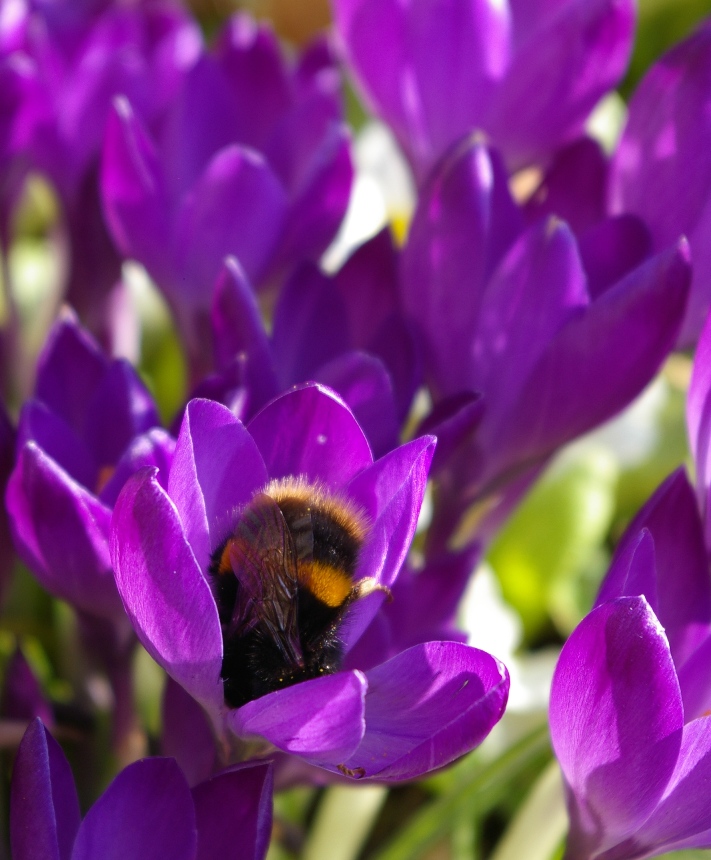
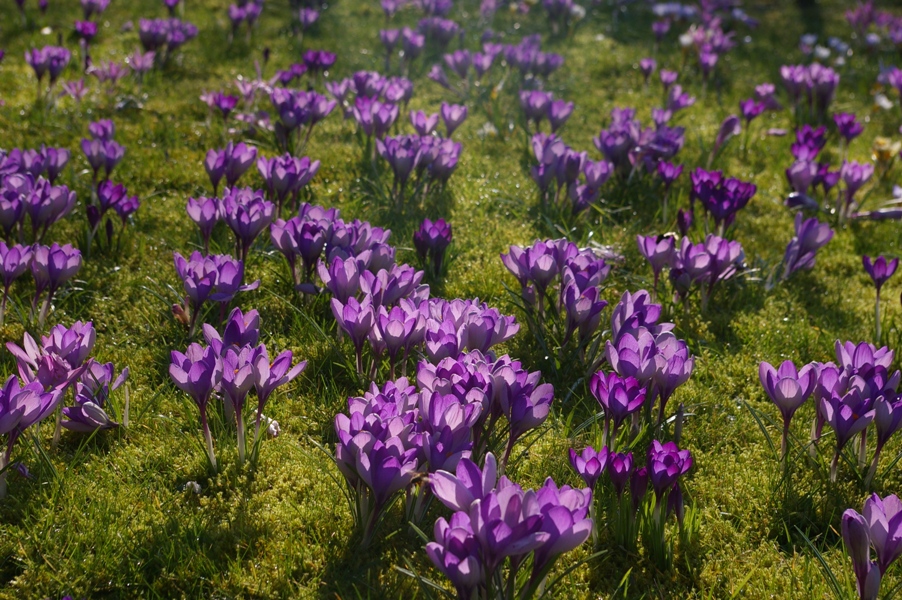
 A misty start gave way to a glorious day of bright warm sunshine and evvery flower in the garden opened up. About once a year there is a day like this when the crocuses dominate the scene and the bees are out in force - a real delight, and I took the opportunity to spend the afternoon outside, tidying up the dead stuff from winter and just enjoying my own garden.

Crocus malyi is an excellent plant for the open garden.

 'Cream Beauty' and 'Blue Pearl' really complement each other very well.

Bumblebees ravaged this clump of purple C. vernus all day; honeybees visited too, but there were three or four bumbles in the flowers most of the time, clambering from flower to flower. I expect a good crop of seed!

A large form of C. vernus with pale tips on the outer segments.

'Yalta', Janis Ruksans' superb selection of C. tommasinianus
× vernus, with grey exterior and rich purple centre.

The garden in late afternoon, covered in crocuses and full of colour.