Thursday, 8 August 2013

Hunting Brook Gardens

Early morning light on Persicaria amplexicaulis 'Orangefields', with Monarda behind.
Lying literally just beyond the Pale, in the West Wicklow hills at about 900' above sea level, Hunting Brook has become one of Ireland's famous gardens since its inception about ten years ago. Jimi Blake was fortunate enough to inherit a subdivision of the family estate that has enabled him to create a garden to his own taste and requirements, and to use it and his home as a base for his business of horticultural consultancy, and for running courses and seminars on many aspects of gardening and the holistic life. More information is available on the Hunting Brook website.

Hunting Brook has featured in many of the 'glossies' over the years and the spreads are framed on the walls. Perusing them immediately highlights the most important fact about this garden: it is experimental and ever-changing. It is different every year as Jimi investigates other options and combinations, aiming for different effects with his plant material, old and new. Few people are as assiduous in trawling in the nurseries of these islands! The result is therefore an always fresh, always inspiring garden: Jimi's view is that the maximum lifespan of a planted bed is four years.

Airiness and elegance are two key words here: although the palette of perennials and grasses is similar to that used by many designers,  there is never any feeling of blockish painting by numbers, and one knows that there is plenty of seasonal change here too. This is a very serious plantsman's garden after all, and diversity is important, but it is achieved with harmony throughout.


A green and yellow area near the house showing the skilful paring of shades and textures of flowering plants and foliage: Primula florindae in the foreground, with Ligularia 'Britt-Marie Crawford' behind.

Glimpses of the landscape beyond: the slight feyness of Hunting Brook accords with its upland location.

A steep-sided valley runs through the property, carved by the Hunting Brook. with a canopy of a larch plantation above, it is a perfect place to grow ferns, both wild and cultivated, and is being transformed into green lushness.

The site includes this Bronze Age ring fort and a standing stone in the adjacent meadow.

Aralia echinocaulis was introduced to cultivation by the Glasnevin Central China Expedition in 2003, in which Jimi Blake was a participant. It is used repeatedly through the garden as a leit motif: with its prickly stems and enormous leaves it is a magnificent plant. This must be the largest in cultivation, growing through a hole in the deck in front of the house.
Lovely though the gardens are in full daylight, the quality of the planting is best seen very early in the morning, as the east light strikes the hillside.Being fortunate enough to be staying in the Garden Room, with a door straight outside I was able to get out to capture a few pictures while the light was at its most magical. It will be interesting to compare them with what I find on my next visit.

The golden gleam of early morning.

Filipendula purpurea 'Elegans' is used in large drifts and becomes incandescent in the low morning light.

It is astounding that no British nurseries (according to the RHS Plant Finder and database) stock Geranium 'Mount Venus', which, as seen at Hunting Brook at least, is an incredibly good plant, flowering for months on end. Here it is with Linaria vulgaris 'Peloria' and Stipa gigantea.

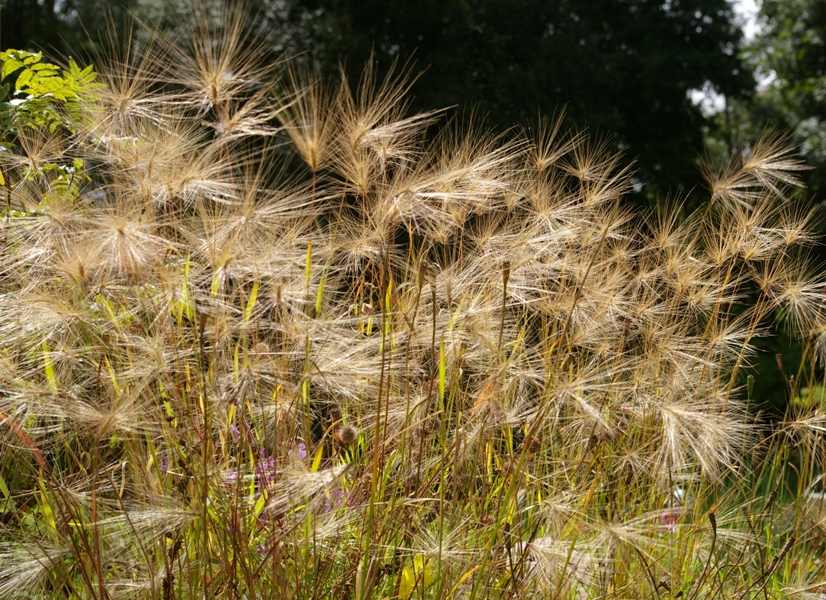
Even the native and usually rather weedy Wall Barley, Hordeum murinum, sems to grow in just the right place to catch the light.

Tuesday, 6 August 2013

An Irish sampler

An early morning view of Monarda and Angelica at Hunting Brook, Jimi Blake's garden in west Wicklow.
I got back yesterday evening from five splendid days of garden visiting in Ireland, based in Co. Wicklow with my friends Jimi Blake at Hunting Brook, and Seamus O'Brien of the National Botanic Gardens, Kilmacurragh. I will write more about the principal gardens visited later, but here is a selection of a shot from each, giving an idea of the diversity of plants and plantings enjoyed on this trip - which, despite appearances, wasn't entirely in gorgeous sunshine. Very many thanks to Seamus and Jimi, and to all the kind people who showed us their gardens.

Rodgersia 'Perthshire Bronze' in June Blake's garden, among trademark lush planting.

A very unexpected sight: Hagenia abyssinica growing in a dustbin in Helen Dillon's garden, Dublin.

Artemisia lactiflora 'Elfenbein' at Mount Venus Nursery.

The old tree of Magnolia delavayi at Kilmacurragh was flowering freely, if fugaciously.

Fagus sylvatica 'Striata' at Birr Castle, where it is known as 'Birr Zebra'

Melt-in-the-mouth white peaches in Robert Wilson-Wright's peach house at Coolcarrigan, Co. Kildare.

The beautiful old garden at Mount Usher lives on its fame: it desperately needs some horticultural competence to restore it to its former glory.

Horticultural loot from the Emerald Isle - though having purchased 15kg of extra baggage allowance from Ryanair I came back with only 6.7kg of plants!

Sunday, 28 July 2013

Poppies

Papaver commutatum 'Ladybird'
 There has been a small flurry of poppies in the garden in the past few days, giving fleeting pleasure. Although sowing annuals in ground infested with weeds was not a good idea really, I couldn't be without them for a whole season.

Papaver rhoeas 'Fairy Wings' - surprising greenish-yellow pollen.

The perennial P. paucifoliatum; this has been the only flower so far on the bits I brought from Colesbourne and in some way the single flower accentuates the intensity of the orange colour.

My favourite: Pam and Sibylle's pure white P. somniferum, my plant of the year 2011.

It combines well with other plants - Anthemis 'Tinpenny Sparkle' and Heuchera 'Raspberry Ripple'

Less welcome, the weedy but demurely pretty Papaver dubium, of which I have pulled out thousands of plants during the course of the spring and summer.

Friday, 26 July 2013

90 minutes at Wisley

The Laboratory seen from the Bowes-Lyon Rose Garden, in which the roses are cunningly concealed among masses of perennials.
A meeting took me to RHS Wisley on Tuesday, but for once I was actually able to get into the garden too - for all of an hour and a half. As it was before opening time it was very peaceful - no yummy mummies and their offspring - and I had a very pleasant if quick walk round. The garden was looking magnificent, full of colour and interest despite the hot, dry spell, with only a few areas of crispy grass. These are a few things that caught my eye and made a good picture.

Stipa gigantea and Rosa 'Goldspice' combine well in the Bowes-Lyon Rose Garden.

Attractive, innovative bedding near the entrance: Lagurus ovatus dominates the centre of the bed, with a Verbena.

Sempervivum with Deschampsia behind.

Allium heads with Nassella tenuissima

There were some striking clumps of the South African Mentha longifolia at the foot of the rock garden, attracting many butterflies: I've never seen such a floriferous mint.

Lilium lankongense

Waving masses of sweet peas in the trial on the Portsmouth Field, scenting the air around.

The current Phlox trial, after a slow start, has come good at last and is showing off an incredible diversity of cultivars, mostly of P. paniculata: it is an extraordinary sight.

The impact of the trial is made more remarkable by the apparent juxtaposition, but in different rows, of violently clashing colours - but as with cymbals, clashing can sometimes be good. Phlox paniculata 'Betty Towe' in front.

For those who prefer more peaceful shades, P. paniculata 'Grey Lady'. Judging this trial for the Award of Garden Merit will not be easy, though there are no limits on the number of cultivars that can be so awarded.

Monday, 22 July 2013

A gardener's garden

Lush planting characterises the Pottage garden.
 Yesterday afternoon, accompanied by Mark Weathington, Curator of the JC Raulston Arboretum in North Carolina, I visited Matthew Pottage's garden in Withernsea, East Yorkshire, which was open for the NGS. A modestly-sized space around a modest family home, it is rather different in scale to his other garden - he is a Garden Manager at Wisley, with responsibility for the majority of the open-air ornamental horticulture there. Coincidentally, he was named in The Sunday Times yesterday as one of Britains 'young guns' of horticulture, a well deserved accolade. Wisley may be his main patch these days, but it is easy to see where he practised the skills that got him there while still in his early twenties.

The Withernsea garden is now mostly gardened - under strict instructions - by his parents, with occasional visits from Matthew to undertake major work. The arrangement seems to work extremely well, with the garden being immaculate in all respects. It is well-planned to maximise the space available without feeling cramped, and the borders are lushly planted with both flowers and good foliage, while round the house are impressive large pots of succulents. I hope these images convey something of the quality and interest of the garden.

The blue border: Salvia 'Mainacht' and a loosely double Geranium pratense, name unknown.

Persicaria 'Purple Fantasy' with Melianthus major.

Agastache 'Raspberry Summer' is impressive.

A well-placed Sedum morganianum.

The compact vegetable garden is also well-planned for effect.

Not the least impressive thing in the garden: a sculptured leylandii hedge, carefully clipped by Mr Pottage senior.

Mathew Pottage and his partner Kishan.

Stars of the show: a very confiding family of ducklings entertained visitors all afternoon.

Monday, 15 July 2013

Hot weather


Cyrtanthus epiphyticus - a lovely but strictly terrestrial plant from grassy slopes in the Drakensberg.
For the past couple of weeks we have been enjoying some real summer weather, with genuinely hot days in the upper 20s - rather too warm for comfort in the afternoons, but cooling to give delightful evenings. The garden has responded with a spurt of growth (aided by irrigation on occasion) and the borders are finally looking really colourful. To convey the sense of brazen heat, however, here are three brightly coloured plants of South African origin that are flowering now, though all are potted.

Gladiolus flanaganii is another Drakensberg plant, in this case growing horizontally from cracks in basalt cliffs high on the escarpment. Sadly its colour is not as deep a red in cultivation as it is the wild.

Pelargonium 'Stadt Bern' is about as red as 'red geraniums' come - a firecracker of a plant, and modestly sized.

Tuesday, 9 July 2013

In the garden this week

Gillenia trifoliata 'Pink Profusion' with Iris latifolia.
After what seemed like a slow start, the garden here is beginning to fill out and look quite colourful, with some nice things in flower and some pleasing combinations developing. The larger plants are inherited from my predecessor, with my own collection worked around them, but without them the garden would look a bit sparse. Here are a few images taken at different times of day over the past week or so.

Iris latifolia, moved from Colesbourne last year, with golden Anthriscus.

The border in front of the house, with old-established plants contributing most of the show.

Delphinium 'Piccolo': I can't understand why Belladonna delphiniums are not more widely grown. This one is outstanding.

Scabiosa 'Blue Butterflies' (I think), with Calceolaria 'Kentish Hero'

Red Papaver somniferum from the soil seed bank.

Buphthalmum salicifolium 'Dora' and Silene dioica 'Firefly'

Phlomis russelliana with Linaria 'Peachy' and Gillenia trifoliata.

Deschampsia caespitosa 'Goldtau'

Lilium martagon 'Naoussa Boutari' - a very apt name for this Greek selection.