Sunday, 22 December 2013

Christmas arrangements

+Pyrocydonia 'Danielii', Sorbus randaiensis, Juniperus pinchotii, Narcissus papyraceus, Galanthus 'Three Ships', Iris foetidissima, Pinus densiflora on spalted beech.

Pinus x schwerinii, Sorbus randaiensis, Malus baccata, Eucalyptus gunnii

Salix spp., Alnus japonica, Allium cristophii 

Sorbus monbeigii (?), Abies procera 'Glauca', Abies concolor 'Violacea'

Not arranged, just as it is: onions and shallots.

Saturday, 14 December 2013

The Genus Betula


Betula ermanii 'Grayswood Hill' in the Yorkshire Arboretum, October
Earlier this year, the  monograph The Genus Betula  by Kenneth Ashburner and Hugh McAllister appeared from Kew Publishing. With birches now looking good in the beauty of their bark, and recently in the gold of their autumn leaves, this seems a good time to post the full text of a review I wrote for Garden Design Journal, which appeared (slightly abridged) in its October 2013 issue.


‘Long-awaited’ is an apt expression for this book, which has not only been long-delayed, but long-needed as a contemporary review of the whole genus Betula from both botanical and horticultural perspectives.


Curtis’s Botanical Magazine Monographs, published by Kew, are a series of finely-produced, authoritative monographs that continue the tradition of the oldest scientific journal in the world of blending botanical accuracy with horticultural information and fine illustration. The Genus Betula is no exception, being a chunky book full of good photographs and enhanced by many excellent paintings by Josephine Hague and line drawings by Andrew Brown. The authors, Kenneth Ashburner and Hugh McAllister, worked together on Betula for many years before Kenneth’s death in 2010, after which Hugh completed the book, but it is very definitely a joint production bringing together many decades-worth of study, including travel by both authors to study birches in many remote places. One of the results of this is the inspiring arboretum at Stone Lane Gardens, Ashburner’s former home in Devon, where groves of birch saplings from the same collection were planted together. This gives a unique opportunity to study natural variation, but is also very beautiful and well worth visiting. 

Betula medwedewii: a rare species from the Caucasus and eastern Turkey (Yorkshire Arboretum, October).

The diversity of Betula is perhaps surprising. Occurring throughout the cooler – and often coldest – parts of the northern hemisphere, 45 species are recognised here, a mixture of the familiar elegant trees and a number of shrubby species. Although often attractive in the wild, with nice autumn colour, most of the small species are of ‘botanical interest only’, seldom performing well in gardens. Of the taller trees it is clear that there are many possibilities for new introductions bringing new characters to the garden, such as the Vietnamese B. insignis var. fansipanensis with purple-flushed new growth, and for selecting superior cultivars. This book should also serve to remind gardeners of the existence of many fine species that are seldom planted, such as the magnificent B. grossa for which there are no current suppliers in the UK. In these times when tree diseases are so alarmingly prevalent we need as much diversity as possible.


 B. utilis subsp. jacquemontii from the western Himalaya usually, but not always, has good white bark, and numerous selections are valued for this quality. This specimen is at Arboretum Kalmthout (Feb 2013)
The Chinese B. utilis subsp. albosinensis typically has richly coloured bark:, but this and other features form a continuum with the broad species B. utilis. This one from Sichuan is at the reddest end of the spectrum (Yorkshire Arboretum, 2012)


The Genus Betula is principally a botanical book, discussing birches from a taxonomic and biological view. The authors’ reasoning for their opinions is clearly stated and I find it convincing. There are two major nomenclatural changes that will raise a few eyebrows, but from the evidence presented seem sensible: the inclusion of B. albosinensis in B. utilis, as subsp. albosinensis, and the inclusion (also as subspecies) in B. pendula of the Chinese B. szechuanica and the Far Eastern Asian -Alaskan B. mandschurica. In these cases they are taken as representing the extremes in a continuum of variation. For the horticulturist there is a general chapter of the cultivation of birches, reminding us particularly of their shallow-rooted nature and the great desirability of planting them young, and each species has a note on its particular merits or demerits in cultivation. A chapter on birch cultivars by Paul Bartlett, who runs Stone Lane Gardens, is useful but I should have liked to see a fuller description of each, and they are not illustrated, which is unfortunate. All in all, however, this is a useful book and will be a standard reference for years to come.


A less extreme colour form of B. utilis subsp. albosinensis, Purdom 752 from western Gansu, long-known in cultivation as B. albosinensis var. septentrionalis, a name not upheld in The Genus Betula (Yorkshire Arboretum 2012).


Sunday, 8 December 2013

Celebrating Sorbus

An eye-catching duo of Sorbus aucuparia in Welburn, North Yorkshire (November).

During the course of the autumn a very frequent remark in any conversation between gardeners has been 'how good the Sorbus have been this year,' so before it's too late I thought it would be good to celebrate this here. A few species have indeed featured as images in the past couple of months but here is a gallery of others, all pinnate-leaved true Sorbus, that have caught my attention. In reviewing my images the other thing worth mentioning is how fine the weather was for so long this autumn, a counterweight to the horrible protracted winter- although that was probably responsible for the superb crops of Sorbus berries by delaying the flowering until it was warmer and there were more pollinators around. These images were mostly taken of trees in the Yorkshire Arboretum, where we have a good collection (though the nomenclature needs work), but some are from elsewhere, as noted.

The western North American Sorbus sitchensis peaked in August
as did S. californica (labelled S. cascadensis), which had lost both leaves and fruits by mid September.

Also looking good early, but continuing for a long time is the dwarf S. frutescens.

September: S. pseudovilmorinii (foreground) and what we have labelled as S. pteridophylla behind - a fine tree with ivory-white berries.

A mystery: this superbly fructiferous shrubby tree is labelled Brickell & Leslie 12545, a number that really belongs to the recently named S. carmesina (which grows adjacent). The collectors told me this week that both pink- and white-fruited species were growing on the same hillside in Yunnan in 1987. Perhaps a berry got in the wrong bag...

The familiar, large-fruited S. cashmiriana at Dawyck, October.

The magnificent wide panicles and big leaves of Sorbus sargentiana make it an outstanding garden plant. This is at Colesbourne Park, October.

Striking clusters of fruit on S. esserteauiana 'Flava' in October

and in late November.

Fading colours but still attractive: S. pseudovilmorinii and S. pteridophylla again, November.

Still at its peak this weekend - the fieldfares and redwings are busily stripping most of the trees now, but seem uninterested in this, which we have labelled as S. monbeigii, Forrest 23890.


Sunday, 1 December 2013

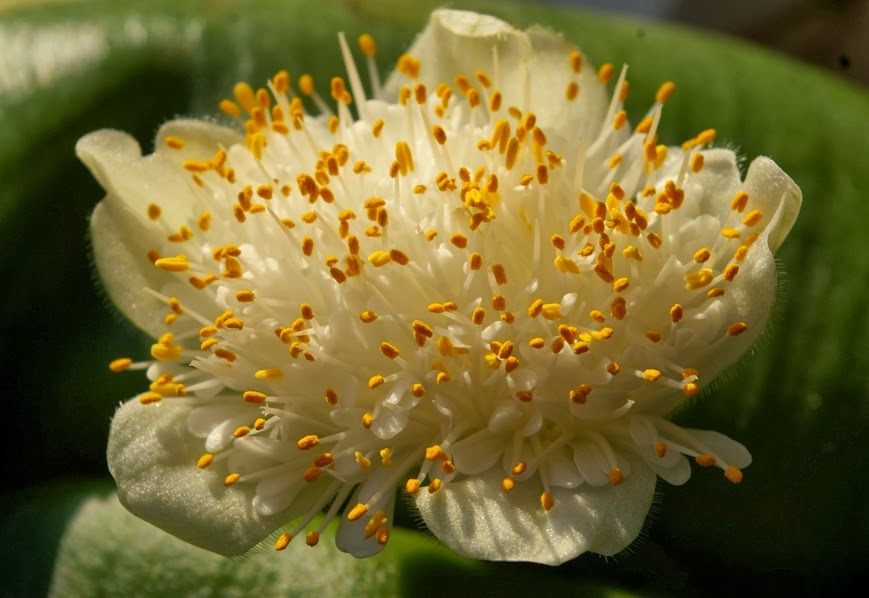
Haemanthus deformis

Haemanthus deformis
While hanging up some laundry to dry in the spare bedroom this morning, I noticed the sun was catching the inflorescence of my plant of Haemanthus deformis on the windowsill, so went for the camera.

The genus Haemanthus (Amaryllidaceae) comprises 22 species from South Africa, of which the pinkish-red flowered H. coccineus from the Cape is probably the best known. It was one of the earliest South African plants to be imported to Europe, early in the Seventeenth Century. H. albiflos is also quite commonly grown, as an almost indestructible houseplant, with white flowers in tight heads. According to Dee Snijman, in her book The Genus Haemanthus (1984), H. deformis has at times been confused with H. albiflos but they are quite distinct in many different ways, notably in the foliage. In H. albiflos the leaves are hard-textured and usually recurved, and 4-6 may be present at any time, whereas in H. deformis there are only two at any time. They are softer and firmly adpressed to the ground. In a pot this is challenging for them, so they do their best and mould themselves over the rim. The inflorescence appears from between the leaves in early winter, in its early stages being seemingly squeezed out  in a narrow wedge.

Numerous flowers are held between soft white bracts.
As with all Haemanthus the inflorescence is formed of a number of flowers held between bracts, which with the protruding stamens gives it the look of a shaving-brush. I think H. deformis is a very pretty plant and prefer it to the red-flowered ones I grow, now rather coarsely in leaf having flowered in September. It comes from the Eastern Cape and southern Kwa-Zulu Natal: this plant, given to me by a friend several years ago, was grown from seed collected near the coast in Eastern Cape. It just sits on the windowsill (greenhouse formerly), gets watered occasionally, and does its thing. Eventually the old leaves get ratty and die back, but the new pair has usually replaced them before they are completely withered.

 Haemanthus may not be the showiest of bulbs, and the large leaves of some can be inconvenient, but they are attractive and interesting and have a modest following - there's even a Facebook group devoted to them.

This year the scape has lengthened more than I've seen previously, showing how densely hairy it is.

Tuesday, 26 November 2013

A charming calendar


Today's post brought a charming gift from my Romanian friends Criss Barsony and Razvan Chisu in the form of a gardening calendar they've put together for 2014. It combines Criss's whimsical illustrations with Raz's horticultural tips for each month: I'm not really a great fan of wall calendars, but this one is an exception and I anticipate 12 months of pleasure (and reminders) from it. The calendar is available via Criss's website (though you'll need to send her a message to arrange payment) where the range of her artistic talents in different media can be seen.


January: time for seed catalogues.

Raking leaves in November: a bandy-legged cat inhabits many scenes.

Monday, 25 November 2013

Late colour at Westonbirt

Japanese maples under larches.
A talk to the Friends took me to Westonbirt Arboretum today and afterwards Dan Crowley, the arboretum's Dendrologist, was kind enough to walk round the collection with me. Most of the maples had lost their leaves, but a surprising amount of colour remains, and despite the gloomy weather it was by no means drab.These photos are a sampler of the diversity of maple foliage and colours still looking good.

Acer carpinifolium

Acer forrestii (or A. pectinatum subsp. forrestii)

Acer grosseri var. hersii

Acer oliverianum

Acer palmatum

Acer palmatum (labelled subsp. matsumurae)

Acer palmatum 'Seiryu'

Remember to look down, as well as up...