Thursday, 22 August 2013

'Red Gurkha' coming of age.

Roscoea purpurea f. rubra, usually known as 'Red Gurkha', BBMS45
When my plants of Roscoea purpurea 'Red Gurkha' came into flower I thought, 'it's just twenty years since you were introduced' but when I checked, I found that it was actually discovered and brought into cultivation in 1992. I ought to have known this perfectly well as the participants in the Oxford University Ganesh '92 expedition that found it were friends of mine (Bill Baker, Tom Burkitt, Jonathan Miller and their Nepalese counterpart Rhidaya Shrestha) and I'd advised them while planning their trip. Their aim was to locate Pleione coronaria, then a very poorly known species, in the Ganesh Himal in central Nepal and study its ecology. They did this successfully, but the expedition's major triumph was its discovery of not only a red form of Roscoea purpurea but also a new species, Roscoea ganeshensis, as well as introducing R. tumjensis and reintroducing R. capitata and R. alpina.

The red Roscoea was the great excitement, however, and I have a letter from Bill Baker (no fewer than 10 pages!) written a few days after their return to England that conveys this. "6 1/2 weeks of rain, shine, wet, dry, hot cold expeditioning has left us with Pleione coronaria, Iris staintonii, a bright red [double underlining] Roscoea and an interesting Hepatica (?)..."The Red Roscoea occurred around one particular village bearing flowers of a scarlet colour (not purply/red) on small stourt plants. No other colour existed there ... it must have been a true-breeding pop and all indications suggest a new subsp. or maybe species.'

In fact it turned out to be a colour variant of the widespread Himalayan species R. purpurea and when published in what was then The Kew Magazine in 2004 was given the evocative name 'Red Gurkha'. Although we all still know it as this, giving a single cultivar name to a wild population was unfortunate and has caused much confusion since, leading to the publication in 2007 of the epithet forma rubra for all examples of this colour form from the Ganesh Himal. Plants brought back from Nepal varied in the pigmentation of the leaf bases, with some being green and others red: the red-pigmented ones are the more striking. The effect is just visible in the top image. This is an original clone, BBMS 45: it has never produced seeds for me, but others have produced whole battalions of Red Gurkhas, and some very fine hybrids too. It likes rich moist soil and light shade: this clump is in my fern border, which gets sun for only a short period each day: another group, in full sun in the open border, are very unhappy and will need rescuing.

The scarlet flowers of R. purpurea f. rubra are really striking, and unique in the genus. To my knowledge it has only been collected by the Ganesh '92 expedition.

Sunday, 18 August 2013

In the garden today

Monarda 'Gardenview Scarlet'  - my favourite of the reds.

The slightly shadier end of the main border: Nepeta kubanica and Persicaria amplexicaulis 'Dikke Floskes' are conspicuous.

Dahlia 'Twynings Revel'

Too many reds but they are too beautiful to pull out.

An old, very hardy favourite: an apricot Gladiolus dalenii or primitive hybrid, originally from Cotswold Garden Flowers.

Panicum 'Frosted Explosion', with Monarda 'Prarienacht'

In the border alongside the drive: Lythrum virgatum 'Dropmore Purple', Helenium 'Sahin's Early Flowerer', et al.

The drive border in late afternoon: the tall Dahlia is 'Night Queen', a serendipitous garden centre package purchase.

Agastache pringlei comes to life in evening light.

Friday, 16 August 2013

Tilia tomentosa 'Petiolaris'

The best of several Tilia tomentosa 'Petiolaris' in the Yorkshire Arboretum, planted in 1979: still a youngster.
For the past few days the scent of a lime-tree has been blowing about the Yorkshire Arboretum on the warm breeze and perfuming the air most delightfully. The great trees of the Castle Howard avenue finished flowering some weeks ago, so I tracked it upwind to our grove of Tilia tomentosa 'Petiolaris', the weeping silver lime, of which we have about 10 trees, planted in 1979.

'Petiolaris' is one of the noblest of big trees, easily achieving 30 m in due course, and rivalling anything in its magnificence of strong limbs and broad crown, but its great beauty comes from the pendulous branches and the curious twisting of some of its petioles, resulting in the white underside of the leaves being turned upwards. The canopy thus looks silvered at all times, but especially when shivered by a breeze. It has been valued for this feature for a long time - the records suggest it was first planted in England in the 1840s, but its real origin is hazy but it may have come rom the Ukraine. The relationship of 'Petiolaris' to Tilia tomentosa, the common silver lime of the Balkans and eastern Europe, has been debated for years, but Donald Pigott, whose life-long study of Tilia was published last year (Lime-trees and Basswoods, Cambridge University Press), is of the opinion that it is merely an unusual clone of T. tomentosa.

Twisted petioles reveal the white undersides of the leaves.
The flowers are borne extremely profusely, and as noted above, are exceptionally fragrant. They make a delicious tisane when steeped in hot water, and on the tree attract a huge number and diversity of insects. Our trees were humming with the sound of insects today, lovely to hear - what Matthew Arnold called 'the live murmur of a summer's day'.


The flowers of Tilia tomentosa 'Petiolaris' are wonderfully fragrant.

There have been huge numbers of Peacock butterflies in the arboretum in the past week: this one had joined the throng of bees and hoverflies on a 'Petiolaris' tree.

Monday, 12 August 2013

Helen Dillon's Garden

Helen Dillon's garden, from her drawing room: a town garden that seems much larger than it really is, packed with good plants and good planting.
Helen Dillon is the grand dame of Irish gardening, so far as I can tell, and I've not heard of any serious rivals. She speaks as she writes; staccato, brisk, opinionated: but her opinions change, and her garden changes and the high-powered charge that results is what makes a visit to 45 Sandford Terrace, Ranelagh, such an exciting pleasure (see website here for opening information). 

The front garden is a rather formal affair, suiting the Georgian townhouse rather well, with a grove of 51 Betula 'Fascination' along the side; the fireworks begin on the other side, where in the comparatively small back garden Helen has created and re-created a series of gardens over the past forty years, each bringing a new take to her passion for good plants and their appropriate placement. But as she says in Helen Dillon's Garden Book (2007): 'My idea of heaven was (and still is) to indulge in a lavish buying spree. And the consequences? Too bad. Bugger plans.'  But this doesn't mean the garden is a random jumble; the plans may be buggered but the plants are carefully placed, creating striking combinations of colour or texture. Many big plants are in fact grown in pots (or galvanised dustbins) and much of the colour visible in the birders alongside the rill (above) is from such potted plants.

The rill, with its grand parallel borders, is the centrepiece of the garden, best seen from the drawing room. It replaces various incarnations of lawn and borders and fits the space beautifully. Behind these borders are a series of garden areas in parallel: a charming and very well-stocked greenhouse, raised beds, vegetables, an aviary with delightful Diamond Doves and Bengalese finches, a gravel garden, ferns in cool green shade... I often find it difficult to see the garden for the plants, and this was a classic case: being mesmerised by the plants I didn't take many pictures of the garden spaces, and keeping up with the conversation also needed concentration. Helen is a generous hostess and Jimi Blake and I came away with a lot of cuttings and divisions ('I won't look') - I hope I can do justice to mine. Thank you Helen!

The very tall Dahlia 'Admiral Rawlings' - a stunner for a big border.
The striped carnation 'Chomley Farran', found at an antiques fair by Helen and begged from its namesake.

I have been coveting the China Rose 'Louis XIV' since I first saw it in the Dillon garden years ago: a weak, dwarf bushlet, Helen says it needs constant applications of RoseClear, but the velvety flowers from small black buds are worthwhile. Cuttings are now in my propagator.

Helen Dillon and Jimi Blake discussing plants in the gravel garden: in front of them is Verbascum 'Frosted Gold', which Helen has kept going, almost single-handedly, since she got it in the '70s from Mrs Desmond Underwood.

Dublin, not California: Romneya coulteri revelling in the hot summer

For all the changes some things are constant: this superb clump of Veratrum album has been in situ for 40 years.

Cosmos and Verbena bonariensis.

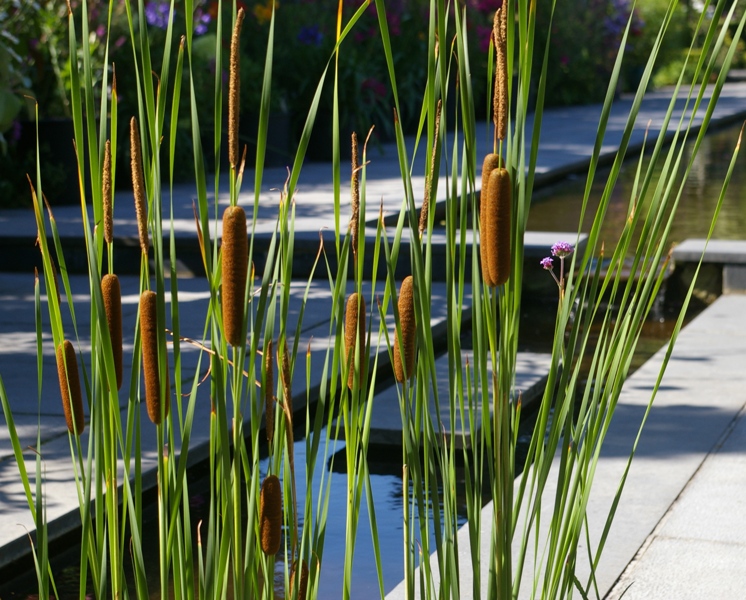
Typha minima and the rill.

Friday, 9 August 2013

June Blake's Garden

The view across June Blake's garden from below an almost horizontal larch.
For a family to have two exceptional gardeners is extraordinary, but such is the case with the Blakes: just down the hill from Jimi's Hunting Brook is his sister June's property, known to the world simply as June Blake's Garden (website here). Both are great, exciting gardens full of good plants intelligently and boldly used: they have similarities but also great differences. The core of June's site is largely flat and lends itself to a more formal design structure - which it has been given - and the main borders are perhaps planted more solidly. Anyone interested in good planting, and good plants, needs to see both: they are entirely complimentary to each other. Many thanks to June for showing me round, and for the plants, seeds, and inspiration I brought away.

June Blake's Victorian home: tradition meets contemporary design in both the garden and in the modern extensions and renovations to the buildings.

Rich plantings in the hot border.

Cotinus 'Grace' and Crocosmia 'Lucifer' - a perfect match.

Veronicastrum 'Fascination' and Artemisia lactiflora 'Jim Russell'

Looser planting characterizes the prairie garden, though here a sinuous low box hedge gives definition between Achillea and Knautia.

Pulmonaria 'Blake's Silver' was a seedling in the garden: it is a very striking plant, here forming a river between very dark-flowered Primula florindae hybrids.

Adjacent to June's garden is the Cow House, a magnificently converted barn available for holiday lets. This is a screen of sheet iron pierced in the shape of Cardiocrinum flowers - a beautiful piece of art.

Thursday, 8 August 2013

Hunting Brook Gardens

Early morning light on Persicaria amplexicaulis 'Orangefields', with Monarda behind.
Lying literally just beyond the Pale, in the West Wicklow hills at about 900' above sea level, Hunting Brook has become one of Ireland's famous gardens since its inception about ten years ago. Jimi Blake was fortunate enough to inherit a subdivision of the family estate that has enabled him to create a garden to his own taste and requirements, and to use it and his home as a base for his business of horticultural consultancy, and for running courses and seminars on many aspects of gardening and the holistic life. More information is available on the Hunting Brook website.

Hunting Brook has featured in many of the 'glossies' over the years and the spreads are framed on the walls. Perusing them immediately highlights the most important fact about this garden: it is experimental and ever-changing. It is different every year as Jimi investigates other options and combinations, aiming for different effects with his plant material, old and new. Few people are as assiduous in trawling in the nurseries of these islands! The result is therefore an always fresh, always inspiring garden: Jimi's view is that the maximum lifespan of a planted bed is four years.

Airiness and elegance are two key words here: although the palette of perennials and grasses is similar to that used by many designers,  there is never any feeling of blockish painting by numbers, and one knows that there is plenty of seasonal change here too. This is a very serious plantsman's garden after all, and diversity is important, but it is achieved with harmony throughout.


A green and yellow area near the house showing the skilful paring of shades and textures of flowering plants and foliage: Primula florindae in the foreground, with Ligularia 'Britt-Marie Crawford' behind.

Glimpses of the landscape beyond: the slight feyness of Hunting Brook accords with its upland location.

A steep-sided valley runs through the property, carved by the Hunting Brook. with a canopy of a larch plantation above, it is a perfect place to grow ferns, both wild and cultivated, and is being transformed into green lushness.

The site includes this Bronze Age ring fort and a standing stone in the adjacent meadow.

Aralia echinocaulis was introduced to cultivation by the Glasnevin Central China Expedition in 2003, in which Jimi Blake was a participant. It is used repeatedly through the garden as a leit motif: with its prickly stems and enormous leaves it is a magnificent plant. This must be the largest in cultivation, growing through a hole in the deck in front of the house.
Lovely though the gardens are in full daylight, the quality of the planting is best seen very early in the morning, as the east light strikes the hillside.Being fortunate enough to be staying in the Garden Room, with a door straight outside I was able to get out to capture a few pictures while the light was at its most magical. It will be interesting to compare them with what I find on my next visit.

The golden gleam of early morning.

Filipendula purpurea 'Elegans' is used in large drifts and becomes incandescent in the low morning light.

It is astounding that no British nurseries (according to the RHS Plant Finder and database) stock Geranium 'Mount Venus', which, as seen at Hunting Brook at least, is an incredibly good plant, flowering for months on end. Here it is with Linaria vulgaris 'Peloria' and Stipa gigantea.

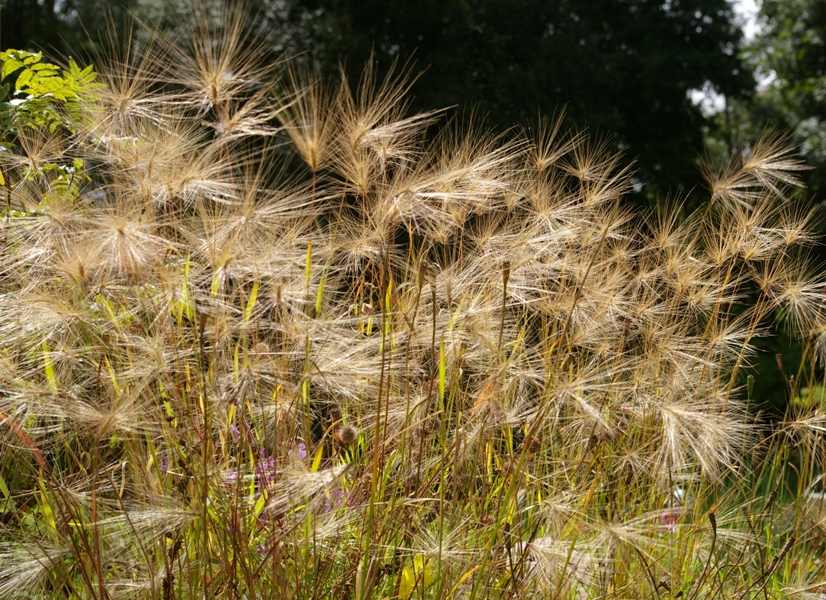
Even the native and usually rather weedy Wall Barley, Hordeum murinum, sems to grow in just the right place to catch the light.

Tuesday, 6 August 2013

An Irish sampler

An early morning view of Monarda and Angelica at Hunting Brook, Jimi Blake's garden in west Wicklow.
I got back yesterday evening from five splendid days of garden visiting in Ireland, based in Co. Wicklow with my friends Jimi Blake at Hunting Brook, and Seamus O'Brien of the National Botanic Gardens, Kilmacurragh. I will write more about the principal gardens visited later, but here is a selection of a shot from each, giving an idea of the diversity of plants and plantings enjoyed on this trip - which, despite appearances, wasn't entirely in gorgeous sunshine. Very many thanks to Seamus and Jimi, and to all the kind people who showed us their gardens.

Rodgersia 'Perthshire Bronze' in June Blake's garden, among trademark lush planting.

A very unexpected sight: Hagenia abyssinica growing in a dustbin in Helen Dillon's garden, Dublin.

Artemisia lactiflora 'Elfenbein' at Mount Venus Nursery.

The old tree of Magnolia delavayi at Kilmacurragh was flowering freely, if fugaciously.

Fagus sylvatica 'Striata' at Birr Castle, where it is known as 'Birr Zebra'

Melt-in-the-mouth white peaches in Robert Wilson-Wright's peach house at Coolcarrigan, Co. Kildare.

The beautiful old garden at Mount Usher lives on its fame: it desperately needs some horticultural competence to restore it to its former glory.

Horticultural loot from the Emerald Isle - though having purchased 15kg of extra baggage allowance from Ryanair I came back with only 6.7kg of plants!