Friday, 18 June 2010

Abbotsbury Subtropical Gardens


Yesterday the RHS Woody Plant Committee held one of its 'away-day' meetings at the Abbotsbury Subtropical Gardens on the Dorset coast, enjoying glorious weather. After business and lunch had been dealt with, we had a tour around the gardens led by the Curator, Stephen Griffiths, who is also one of the committee members.

The Abbotsbury gardens started off as a 19th Century walled kitchen garden for the 'Castle', a mansion built on an exposed site just above the sea as a summer residence for the Earl of Ilchester and his family, still the landowners today. This burnt down in the 1930s, but the gardens, which had been transformed into ornamental grounds, were retained. They had been planted in the Victorian 'subtropical' style, with lots of Trachycarpus and Cordyline and the name has stuck. The gardens have spread out through the woodland of the sheltered valley in which they lie and most of the 30 acre site could be regarded as classic woodland garden, albeit with an emphasis on the more spectacular sorts of plants. Although the Dorset coast is mostly formed of limestone (as indeed is most of the area around Abbotsbury) the gardens occupy a narrow patch of ironstone, giving them acidic conditions. Although the coastal location gives ameliorated conditions, it is not as mild as the gardens of Cornwall or even western Scotland, and this year -7 C was recorded. It did more damage than usual, but there was no evidence of serious losses. We were all surprised to learn that the average annual rainfall is only about 45 cm (20").

The multi-branched crown of Pterocarya fraxinifolia

The natural woodland includes some magnificent, extremely tall native oaks (Quercus robur), but there are also many large Holm Oaks (Q. ilex) providing shelter from wind and frost. Old trees within the garden include a very large Ailanthus altissima and two big specimens of Pterocarya fraxinifolia. Both species give a very lush effect with their large pinnate leaves, but the Wingnut just inside the gate can only be described as awe-inspiring, with a huge trunk and a wide, rounded crown., and gives a very tropical look.

Stephen Griffiths came to Abbotsbury in 1990, just after the January gale of that year had wrought havoc with mature trees and the shelter belt. The gardens were rather run-down anyway, so he has had the opportunity to develop them from a low ebb, tackling them section by section each year. The result is a very attractive garden, now containing a great collection of interesting plants. The self-sowing Trachycarpus fortunei provides some cohesion throughout, but is just one of about eight palm species growing happily. Butia capitata is the most successful of the pinnate-leaved species. Of particular interested is the hybrid xButyagrus nabonnandii, a cross between Butia capitata and Syagrus romanzoffiana (from a genus usually considered to be very tender), that is thriving and showed no signs of winter damage. There a lot of bamboos, some a spreading menace, but others like Chusquea gigantea are magnificent clump-formers. I was particularly pleased to see, at last, the best specimen of Alniphyllum fortunei (Styracaceae) in the country. Originally grown from seed by Roy Lancaster and presented by him to the garden, it is now about 8 m tall, and was in bloom - but only at its top, so the white flowers were hard to see.


xButyagrus (left) and Chusquea gigantea

What may become to be seen as Stephen's greatest contribution to the garden is a broad walk cut through the woodland on the hillside rising above the garden. This has been planted with an avenue of Magnolia campbellii seedlings, with a backing of other, quicker-flowering magnolias, and leads to a viewpoint from which the panorama of Lyme Bay can be seen in its entirety. To the east is the parabola of Chesil Beach linking the Isle of Portland to the mainland with a chain of graduated gravel and cutting off a lagoon, the Fleet, from the sea. It is on this that the famous Abbotsbury swannery is located, and the birds can be seen in the photo. To the west the eye travels past the Golden Cap as far as Start Point in Devon - the first part now being known as the Jurassic Coast in recognition of its rocks' antiquity and their famous abundance of fossils - a wonderful sight in light of Mediterranean quality.

The view eastwards, along Chesil Beach to the Isle of Portland.

Thursday, 17 June 2010

Eucalyptus leucoxylon


Among the many rather tender plants finding shelter in the protected enclave of the Chelsea Physic Garden in London is a small tree of Eucalyptus leucoxylon subsp. megalocarpa, currently flowering prolifically. In yesterday's brilliant sunshine it looked beautiful. It is a native of southeast South Australia and its great point of interest is that it is the hardiest of the red-flowered eucalypts. This individual is one of only a tiny number known to grow and flower outside in this country, where it is only just hardy in the mildest corners.
 
All the eucalypts usually grown outdoors in Britain have white flowers, and while these can be abundant and attractive, lack the wow factor seen in some of the red-flowered species in Australia. The tree at the Chelsea Physic Garden is not a beauty, consisting of three leaning trunks from which the branches hang. Rosie Atkins, the Curator, told me that she believed that her predecessor, Sue Minter, had finally got tired of having it a pot and had put it out to take its chance. As eucalypts very quickly develop girdling roots in pots its leaning posture may be a consequence of a not very adequate root system in the ground. They should always be planted as young as possible to enable good establishment, but in this case the fact that it was an older plant with natured wood may have permitted it to survive where a seedling might have perished.

Tuesday, 15 June 2010

An interesting Kalanchoe


Visiting a garden centre during our visit to Holland in March I spotted a Kalanchoe with double green flowers, so added it to the trolley. The decorative wrapping around the pot informed me it was from the Queen Series of Kalanchoe, developed by the Danish company Knud Jepsen A/S, and from their website http://www.queen.dk/ it was possible to identify this clone as 'Paris'. It developed into a very attractive plant, with neat green flowers, as seen above (photographed 11 April).


The flowers did not fade away in the usual fashion, however, instead developing a central axis that unfurled rank after rank of petals, eventually forming quite long 'tails'. In some of them I have counted 12 whorls of petals, and those that have developed most fully are now showing good reproductive parts at their very centre, demonstrating that this proliferation is taking place behind the growing point of the flower axis - an extreme case of the hose-in-hose flower type. The plant has by now lost any pretence at beauty, so has been deposed from the study windowsill and will be kept in the greenhouse from now on, to be watched for future developments. Today's photograph is to the right.

Monday, 14 June 2010

Bird's-nest Orchid at Colesbourne


The Bird's-nest Orchid, Neottia nidus-avis, is a strange, brown plant entirely dependent on its fungal connections for sustenance- it has little or no chlorophyll and is thus unable to manufacture its own carbohydrates by photosynthesis. Both its English and scientific names refer to the tangled mass of short roots that look like an untidy bird's nest.

The species typically grows in dense shade, especially in mature Beech woods on calcareous soils, and plants can be quite difficult to see as the brown plant blends with the leaf litter. If illuminated by a shaft of light, however, the plants can be seen to be surprisingly handsome and often quite large (up to about 45 cm in height). There is an excellent population in one of the Colesbourne woods (below) where almost all ground vegetation is suppressed by the dense canopy above: of other woody plants only the Yew trees tolerate the low light levels.


Sunday, 13 June 2010

The Black Walnut at Marble Hill

The parkland surounding Marble Hill contains many fine mature trees, although, as was the case across southern England, many fine specimens were lost in the Great Gale of October 1987. One of the survivors, fortunately, is a magnificent Black Walnut (Juglans nigra), which has been noted for many years as one of the finest specimens of the species in this country. It was placed first by Elwes and Henry in The Trees of Great Britain and Ireland (1907), having been measured in 1905 at 98' (29.8m), with a girth of 14' 3" (equivalent to a diameter of 136 cm), but was recorded at 'only' 27 m, with a diameter of 184 cm, by Owen Johnson of the Tree Register of the British Isles in 2001. So although it has put on girth it has diminished slightly in height, but still presents an image of great vigour and has a full crown of branches and foliage. There are now others in England that are taller, or of slightly greater girth than this tree, but it would seem (according to TROBI) that none achieve these proportions of both height and girth with a full canopy.

The old Black Walnut at Marble Hill (I saw a much younger one too) is said to have been planted by Henrietta Howard in the 1720s as part of her landscaping of the park. The species had been cultivated in Europe since the early seventeenth century, being a conspicuous and valuable timber tree of the Virginian forests - indeed, it was one of the most important and largest-growing constituents of the native North American forest, a giant amongst the giants. In this country it really appreciates the warm summers afforded by south-eastern England, and at Marble Hill it was able to get its roots into rich alluvial loam, not far from the Thames, which must account for its great size. Juglans nigra is seldom planted these days; a shame, as it is one of the great parkland trees if there is space, but I was heartened (in a slightly apprehensive way) to see a hearty young specimen of it for sale, crammed into a 10 litre pot, at our local Countrywide shop today, for £22.95. With their vigorous taproots walnuts do not like confinement in pots, or the trauma of disturbance, but perhaps this one will be bought soon and quickly planted, preferably following Henry John Elwes's recommendations:  'it should be sown or planted in small, deeply-dug patches in a rich wood, kept free from weeds and protected from mice, rabbits, and boys...'

The nuts of J. nigra seldom ripen well in England, but are edible when they do, having a distinctive strong flavour. Unfortunately the architecture of the shell is so convoluted and ribbed that it is impossible to extract the meat neatly, so they are sold as cracked fragments in American supermarkets. My mother once converted a packet of them into very tasty biscuits for me, and when in Oregon in March I had a 'shake' made with Black Walnut ice cream that was delicious (but very calorific).

The lush foliage of the Marble Hill Black Walnut

Palladio in west London


Chiswick House

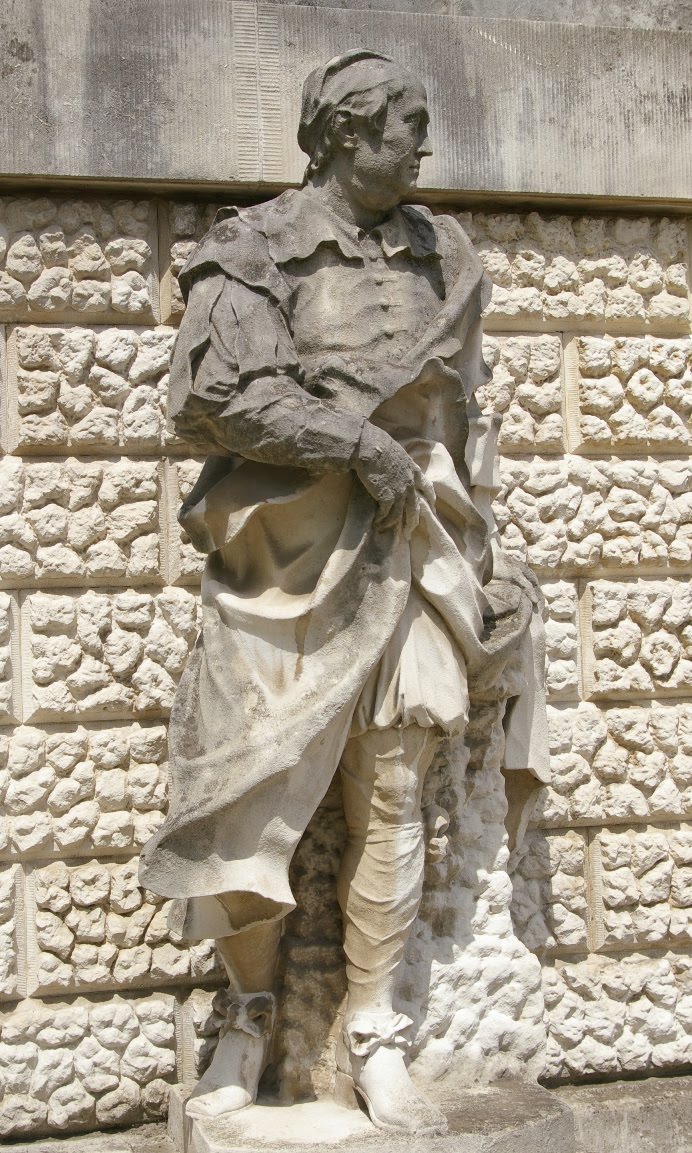
On our way to Pope's Grotto yesterday we visited two houses (and their parks) with which he was closely involved and which had huge influences on British architecture and landscape gardening. Alexander Pope's great patron and friend was Richard Boyle, third Earl of Burlington (1694–1753), the 'architect Earl'. As a young man on the 'Grand Tour' of Italy he discovered for himself the neoclassical works of Andrea Palladio (1508-80), collecting not only the Quattro Libri but original drawings, and becoming a highly skilled architect himself. A statue of Palladio commissioned by Burlington (right) still stands outside Chiswick House - on the further side is his other great hero of the classical revival, Inigo Jones. While encouraging the adoption of Palladian, neoclassical architecture by his fellow aristocrats, with the results to be seen in so many of England's stately homes, Burlington demonstrated his taste and skill on his own properties too.


His greatest design is perhaps that for the villa now known as Chiswick House, but which originally formed an adjunct to the earlier, adjacent house of that name. This exquisite building still sits in its park, essentially as Burlington planned it (though a nineteenth century walled garden and fine conservatory, currently under restoration, have been intruded), but hemmed in between two of west London's main transport arteries that destroy the sense of rural idyll that must have prevailed in the 1720s. Pope was a regular visitor at Chiswick, and must have had a great influence on Burlington's thoughts on landscape, but even more important was his associate William Kent, who became the greatest of early landscape gardeners. Horace Walpole wrote of him 'He leaped the fence, and saw that all nature was a garden'. The garden at Chiswick House was originally rather formal in the classical fashion, and some of this survives- a patte d'oie of allees, and an avenue of urns and cypresses, for example, but Kent softened it round the edges, bringing romantic informality to the park. This is perhaps most evident in the irregular edges of the lake, originally a formal canal, still flowing from the cascade he built.

Marble Hill from the south, facing the Thames

A mile or so east of Pope's Villa at Twickenham is the perfect Palladian mansion, Marble Hill. It was built from 1724 for Henrietta Howard (1688-1767), with funds provided by George II, whose mistress she had been when Prince of Wales. It is not a particularly large house - certainly no grand stately home, but the perfectly proportioned residence of a lady of taste. It is set in wide parkland,  laid out by Pope and the landscape architect Charles Bridgeman, but its great significance is the aspect it presents to the river at the end of the lawn, ' giving the Thames an air of the River Brenta', according to Mavis Batey. It is at the heart of the so-called 'Arcadian Thames' landscape running from Richmond Hill to Hampton Court, which forms the first view in the world to be given legal protection (by Act of Parliament in 1902).

Inside the house is a series of elegant rooms; surrounding a pillared hall on the ground floor; around the gilt 'Great Room' on the first floor or piano nobile; while on the second floor a picture gallery runs the width of the building. The original furnishings were dispersed long ago, and the pictures were all sold in 1900. Despite this the house has been meticulously refurnished by English Heritage and some of the original paintings, especially the five capriccios painted by Giovanni Paolo Panini, from the Great Room, have been tracked down and bought back. Where the original paintings are not available, appropriate substitutes have been provided. Henrietta Howard was fond of chinoiserie, aparently much to the disgust of her friend the Earl of Burlington, and the house has been redecorated with this in mind. A recent restoration has been the hanging of the dining room in new, hand-painted chinoiserie-style wallpaper made for Marble Hill by de Gournay of Chelsea - a wonderful confection of exotic birds and flowers.

Both Chiswick House and Marble Hill are owned by English Heritage, and have limited opening hours (Chiswick House is not open on Saturdays!) - information is available on their websites. Their grounds are now public parks run by the local municipalities, and are evidently extremely popular. The surroundings of Chiswick House are undergoing restoration under the supervision of the Chiswick House and Gardens Trust, and several features are currently under wraps, but they should be magnificent when complete, once again complementing the architectural gem at their heart.

Marble Hill from the north

Poppies


Corn Poppies (Papaver rhoeas) in a rape field above Coberley, upper Churn valley, today